
How to make felt slippers
This month writer and stylist Rachel O’Brien headed to the Fluff-a-torium in Dorking. She learns how to make felt slippers with felt guru Gillian Harris, aka gilliangladrag.
Follow the step by steps and create your own super-cosy felt slippers. There are also lots of expert tips from Gillian herself as well as ideas to inspire you in the gallery at the bottom of the post too.
Check out my blog post to help you source the best wool for felting. Hope you enjoy!
Key takeaways before we jump in
1 Wet felting creates handmade slippers by layering wool fleece (also called wool tops or roving) over polystyrene shoe lasts, then rubbing with soap and water to bond the fibres before fulling in a washing machine to shrink and harden the material.
2 The slipper-making process requires three layers of wool fleece applied to shoe lasts, with decorative designs added to the third layer before rubbing for 10 to 20 minutes to secure all elements.
3 Completed slippers must be fulled in a washing machine with friction-creating items like old jeans, typically through two wash cycles, before the polystyrene lasts can be removed and the slippers shaped and dried.
4 Finished felt slippers can be professionally soled at shoe repair shops to extend their durability and allow for indoor-outdoor wear.
“The shoe repairer did look at me a little bit quizzically,” says master Fluff-a-tier Gillian Harris. She is describing the time she took a pair of felted slippers to the shoe menders to be soled. Clearly not everyone is as well versed in the joys of felt as Gillian.
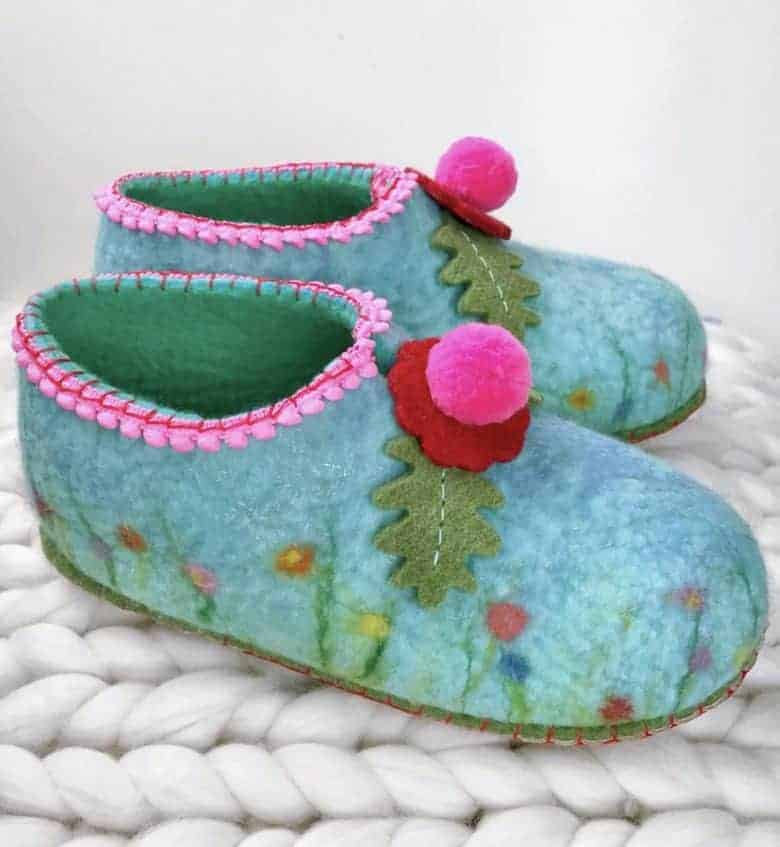
How to make felt slippers
Gillian has turned felt-making into an art form and her creations have graced the pages of many a magazine. Her felt-making kits are for sale in John Lewis and Liberty. Gillian’s books are available in several languages and on sale around the world.
As a keen knitter myself, I’m used to working with wool but I have never tried making felt before. So this wet-felting workshop is to be a voyage of discovery for me. Not one to turn down a challenge, I make my way to Dorking and Gilliangladrag’s Fluff-a-torium. I would be learning how to make felt slippers.
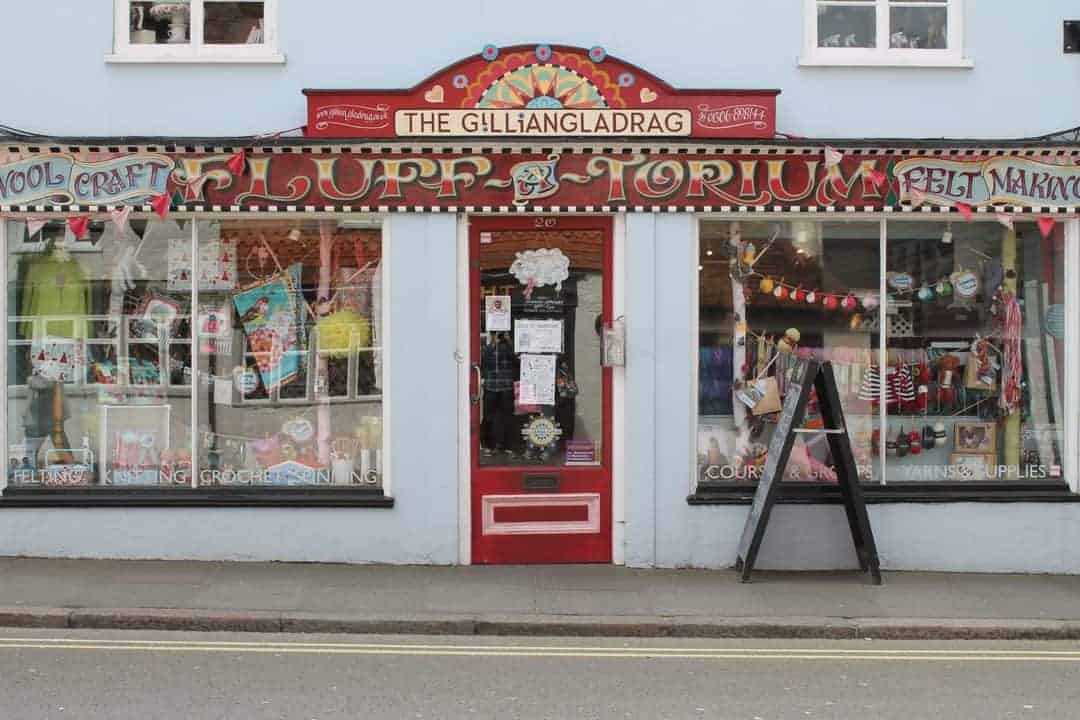
The fluff a torium
A short walk from Dorking West train station, the Fluff-a-torium is easy to spot. The facade is bright and quirky with festoons of felt bunting.

Inside is just as inviting. Shelves, stands and cabinets are filled with balls of wool, ribbons, buttons and all manner of felt items. I immediately feel abuzz with creative energy.

Gillian Gladrag
The felting workshop is to be held upstairs in Gillian’s studio. Myself and the three other students are keen to get started as we take in the array of rainbow coloured slippers.
After a cup of tea and a chat, Gillian gives us a step-by-step demonstration. She describes the various styles that we can cut our finished slippers into. We can go for mules, booties or ballet pumps with different sole options.


How to make wool felt
Handmade felt is made from sheep’s wool called wool tops or roving. Sometimes it is also referred to as wool fleece, and has been cleaned and combed. To make felt, the wool fleece must first be rubbed with soap and water so that the fibres begin to join.
The material is then ‘fulled’ – a process which shrinks and hardens the wool to make it thicker. By the end of the day we would all leave the Fluff-a-torium with a pair of shoe lasts covered in wool fleece to ‘full’ in our washing machines, ready to shape and decorate at home.
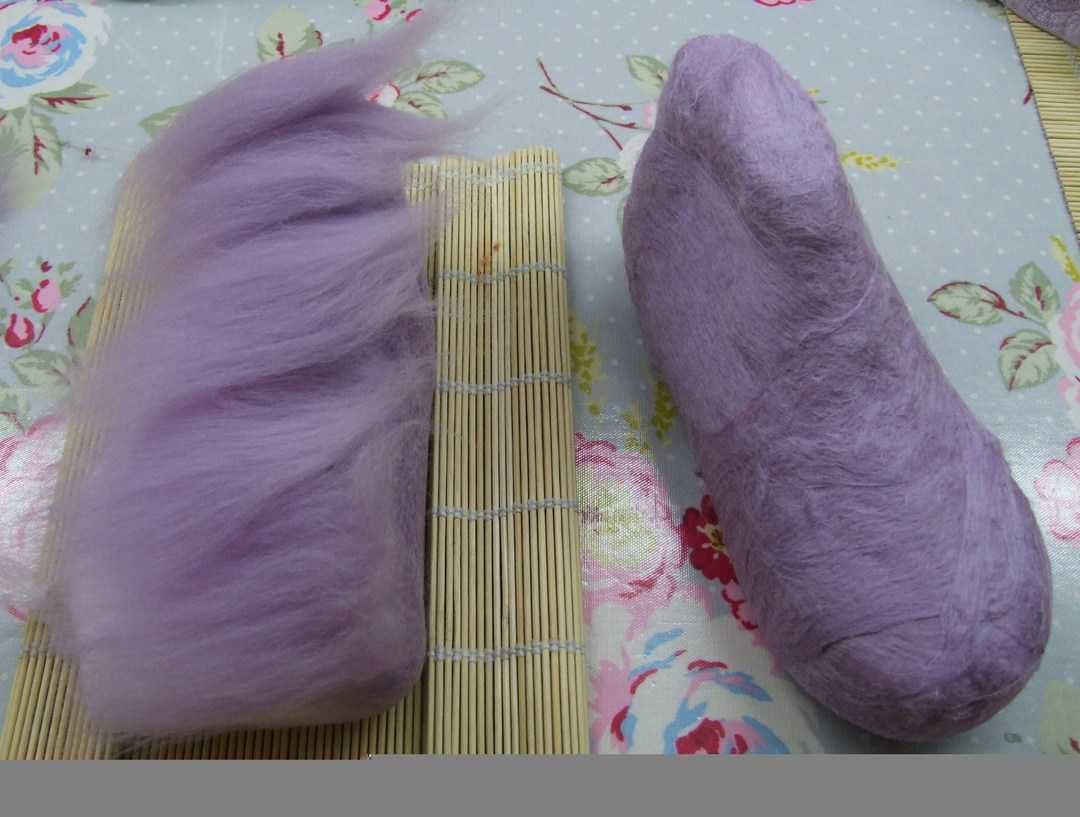
To make our slippers we first need to cover the polystyrene shoe lasts with three layers of wool fleece. Spoilt for choice, I finally settle upon lilac for the first layer, fawn for the second and a dark purple for the outer.
Wool Fleece Preparation & Layering Guide
| Layer | Purpose | Rubbing Intensity |
| First Layer | Foundation structure and inner lining | Firm – secure to last |
| Second Layer | Builds thickness and insulation | Firm – bond to first layer |
| Third Layer | Outer appearance and decoration base | Gentle initially, then firm after design |
| Decorative Elements | Visual appeal and personalisation | Very firm – 10-20 minutes |
Covering the shoe lasts
Gillian sells the polystyrene slipper lasts we used here To be honest, they’re a bit too boot-like for my taste. I have found this really useful tutorial to make your own lasts using tape and old plastic bags – which you can adapt to your own foot size and required shape.
Laying one of my shoe lasts on its side, I start to tease out strands of lilac wool fleece and lay it on top. With a piece of polyester netting covering the last, I spray it with soapy water and rub until the wool is firmly in place.
I continue the layering process until the last is completely covered and resembles a ‘bearskin’ as Gillian describes it. We repeat this for the other shoe last and for our second layer, before taking a much needed break for lunch.

Adding designs
After lunch we add our third and final layer of wool fleece. As we would be applying our designs on top of this, we only rub the wool fleece gently this time.
Once our designs are in place we rub firmly for around 10 to 20 minutes. This is to ensure the fleece and any decorative felt is secure.

Watching Gillian, working on a pair of felted slippers throughout the day, she effortlessly creates a simple floral motif around hers. I opt for a similar design.
Using oddments of wool fleece in complementing colours I create five or six ‘roses’ around each last and then apply soapy water and rub until they were in place.
Throughout the day the atmosphere is very relaxed. Gillian also demonstrates how to make needle-felted roses to decorate the slippers so that we can make them ourselves at home.

Rubbing with soapy water
Back home, I continued to apply soapy water and rub my shoe lasts until the wool fleece was firm. Apprehensive, I put both lasts into the washing machine along with a pair of old jeans to add friction.
With the slippers rattling around I was quite worried about how they would turn out. However I followed Gillian’s guidelines and kept them in for a second wash and spin to toughen them even more. With the wool now fulled, I carefully cut out the slipper shape and removed the polystyrene moulds. Now it’s time to allow the slippers to dry out.

Decorations to try
Gillian showed us how easy it is to make felted wool roses and flowers to decorate our slippers if we wanted to. I decided to keep mine simple, but if you feel like adding a felt rose, it’s really easy. Just cut a length of felt in your chosen colour and then wind around, starting with a tight wind at the beginning and then loosening out the outer ‘petals’ as you go. Hold the base tightly as you go and secure with a few stitches underneath. Then simply stitch on to your finished slippers.
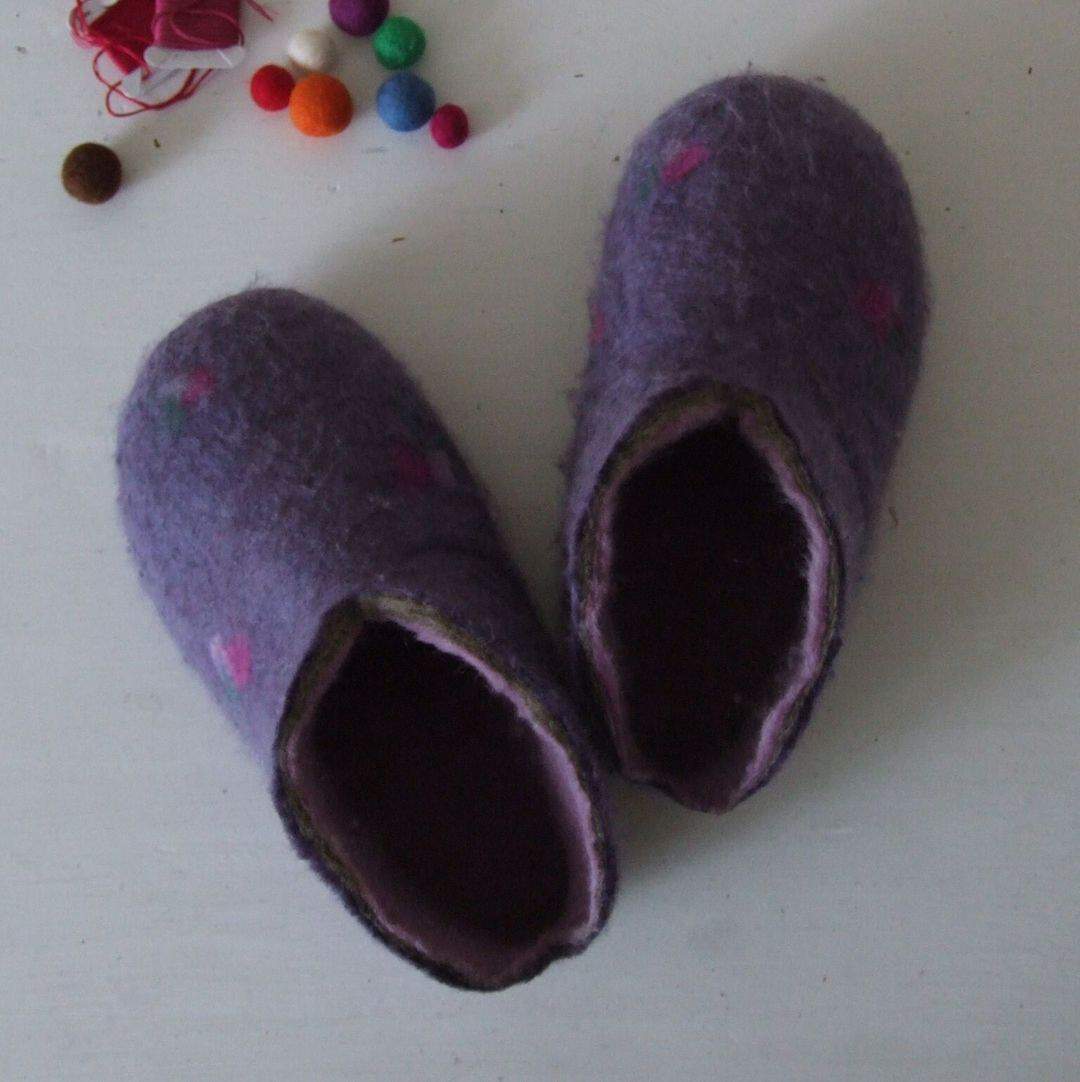
The finished result
The result is a beautiful pair of cosy lilac slippers with pretty rosebuds. They are perfect for warming my toes in front of the fire this Christmas.
This one-day course is ideal for anyone wanting to try their hand at something a little bit different. The making process is quite unusual and the finished product is truly unique.
Alongside felted slipper workshops you can also learn how to make felted bags, jewellery, hats and pictures. All I have left to do now is have my slippers soled. I think I’ll brave my local shoe menders… I wonder how he will react?
5 things to remember
#1 Wet felting transforms loose wool fleece into solid slippers through a three-layer building process on polystyrene lasts, followed by soap-and-water rubbing and washing machine fulling that shrinks and hardens the material by 30-40%.
#2 Machine fulling with old denim creates professional results by providing friction and agitation that locks wool fibres together permanently – something hand-rubbing alone cannot achieve as effectively or quickly.
#3 Decorative elements must be applied to the third layer before final rubbing and require 10-20 minutes of firm pressure with soap and water to ensure they bond permanently to the slipper surface.
#4 Finished felt slippers can be professionally soled at shoe repair shops to transform them from indoor-only footwear into durable slippers suitable for light outdoor use, extending their practical lifespan significantly.
#5 The choice of slipper style – mules, booties, or ballet pumps – is made after fulling by carefully cutting the felted material while still damp, allowing for customisation based on personal preference and foot shape.
Buying the materials online
Check out my blog post: Best wool for felting expert guide to all the types
Gillian’s online shop has many of the materials you need to make your own pair of slippers.
The slipper lasts are also available to buy from Gillian’s shop
Felt and suede soles are available to buy too
Natural British carded wool is available to buy on Etsy here
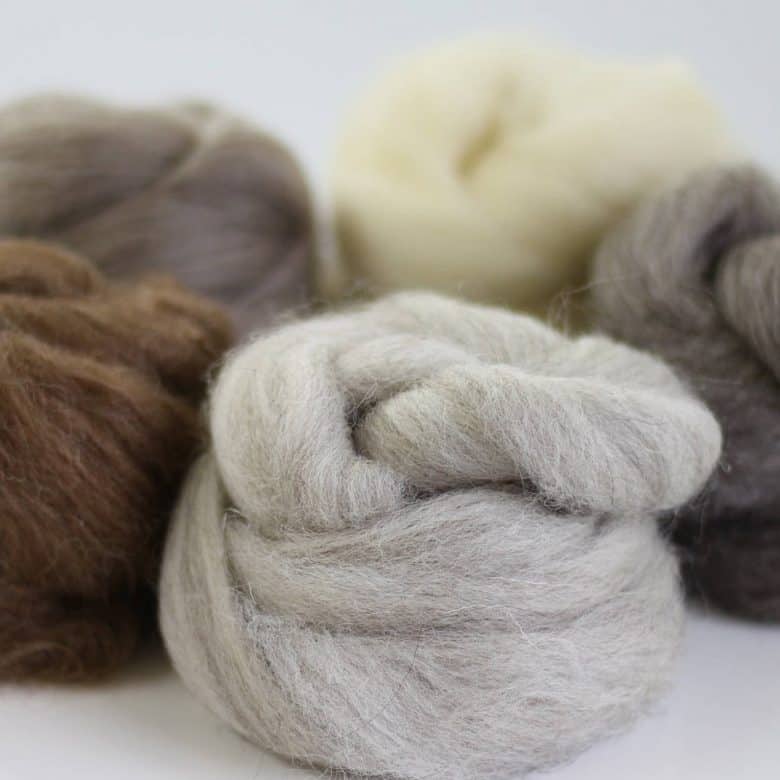
British Breeds natural felting wool
Ideas to try (or buy!)…
The Secret Washing Machine Technique That Transforms Wool Into Durable Footwear
Most crafters don’t realise that a standard washing machine is the secret weapon for creating professional-quality felt slippers. Here’s what makes this technique so effective:
The Science Behind Machine Fulling
• Friction + Heat + Agitation – The washing machine creates the perfect storm of conditions that hand-rubbing simply cannot replicate consistently
• Add Old Denim – Throwing in a pair of old jeans dramatically increases friction, accelerating the fulling process by up to 40%
• Double Cycle Method – Running two full wash cycles ensures the wool fibres are completely locked together, creating slippers that can withstand daily wear
What Happens Inside the Machine
The polystyrene lasts protect the shape whilst the wool shrinks around them by approximately 30-40%. The tumbling action forces the microscopic scales on wool fibres to interlock permanently – something that would take hours of hand-rubbing to achieve. The temperature change between wash and rinse cycles further encourages this bonding process.
Why This Changes Everything
This machine method means you can create shop-quality slippers at home without the traditional hours of hand-fulling. It’s the difference between an afternoon project and a week-long commitment.
Now I’ve had a go at making my first pair of felt slippers, I’m looking for inspiration and ideas for my next pair…! What do you think of these ideas I’ve found? I reckon they are all do-able following the same basic technique with a few moderations here and there – which would be part of the creative fun. They are also available to buy if you just fancy going down the easy route… You could always tell yourself it’s creative ‘research’ for the next pairs you’ll make yourself!
To source the best wool for felting, check out my blog post: Best wool for felting expert guide to all the types
From WildLlama in Welwyn Garden City
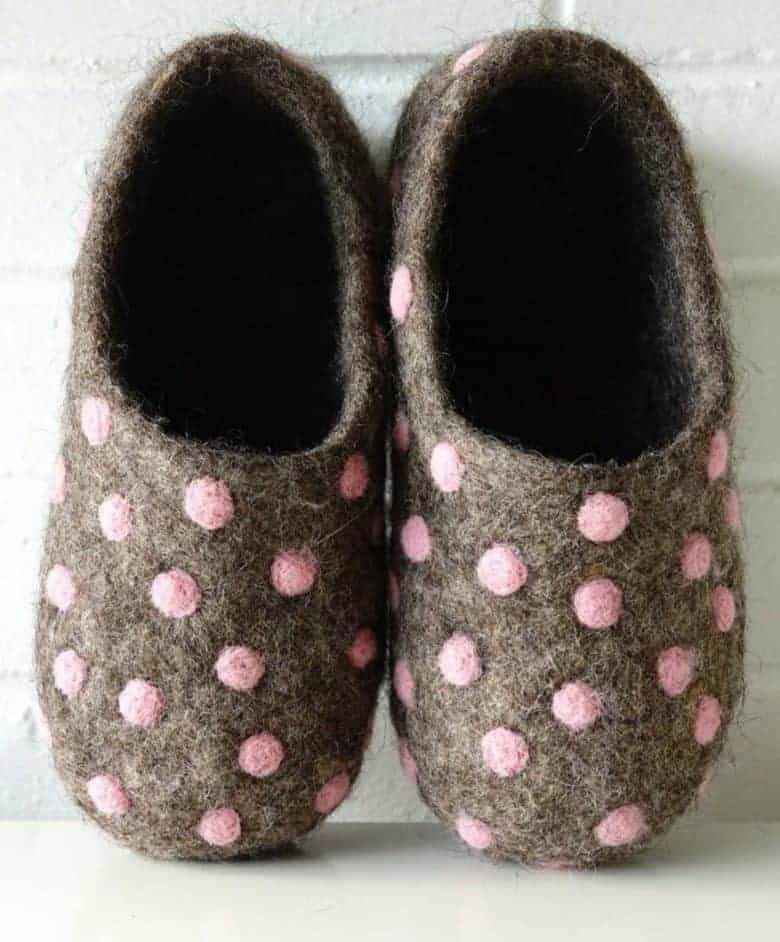
Wild Llama felt slippers are made completely by hand using eco-friendly, non-dyed wool, hot water and soap. I’ve picked out my three favourites:
How cute is this dotty pair?
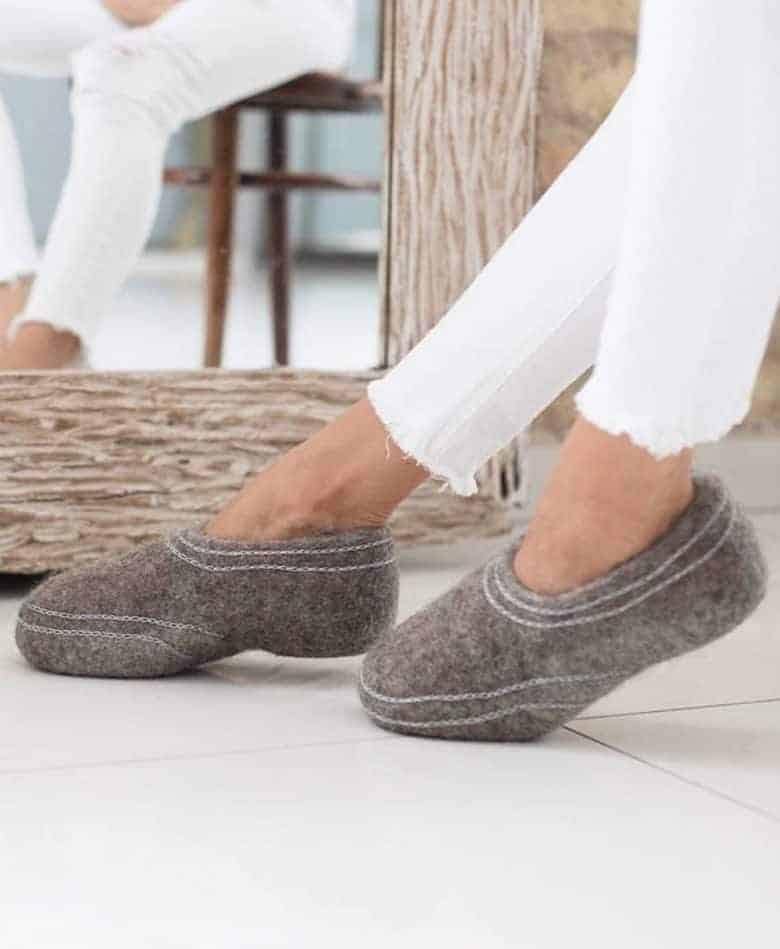
I really like what adding a few rows of simple stitching adds to this pair…
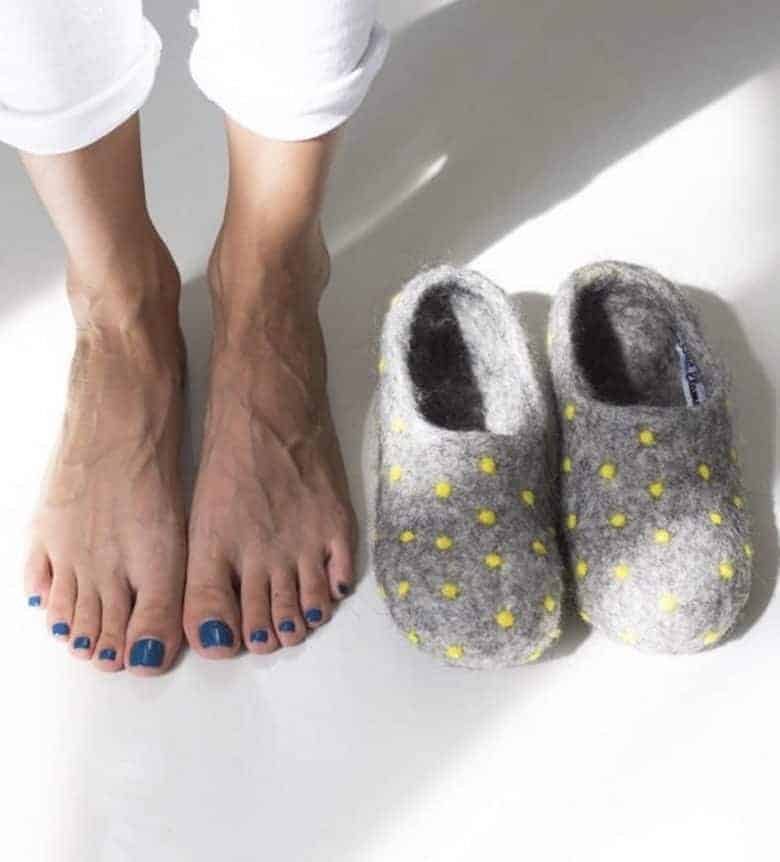
Last pair from Wild Llama: grey wool with smaller yellow dots. There’s a scandi feel to this design that I love.

From Onaie London
And aren’t these grey flower felt slippers with pretty daisy flower decoration just lovely? I like the cutaway design at the sides with a little bit of inserted elastic – worth bearing in mind for making your own.

BUY GREY FELT WOOL SLIPPERS WITH FLOWER DECORATION ON ETSY NOW
And for an extra cosy touch, how gorgeous are these grey felt slippers with sheepskin lining?

Daisy felt slippers from Bamboshe
Love the design of these beauties too – almost a Birkenstock shape with pretty orange and navy wool daisy/flower decoration.

BUY ON ETSY NOW
Slippers by Handmade From Scotland
Handmade slippers from Aura Que in Hastings
There’s a rainbow selection of handmade eco felt mule slippers from Aura Que – all with suede soles.


I really love this collection by Aura Que – and they have suede leather soles. That’s definitely a step on from what I’ve made myself so far, but it would mean you could wear your slippers so much more…
You might also like
Needle felting books: my top 15 best for beginners
INFORMATION
gilliangladrag is listed in the From Britain with Love directory
Get all the info you need to connect with gilliangladrag from the listing >>
Feeling inspired? Take a look at the Creative Workshops category in our Directory,
Gillian is the author of felting books: Complete Feltmaking

Rachel O’Brien is a freelance writer and stylist. All workshop images courtesy of Rachel O’Brien.
If you run a creative course you think our readers would be interested in reading about, do get in touch. Email us at editor@frombritainwithlove.com
This article contains affiliate links, which means we may earn a small commission if a reader clicks through and makes a purchase. All our blog posts are independent and in no way influenced by any advertiser or commercial initiative. By clicking on an affiliate link, you accept that third-party cookies will be set.
A pin to share to Pinterest


Very nice
Thank you – glad you liked the post. Have you made a pair of slippers?
Oh how I wish I still lived in Britain! Would love to try this but no idea where to find the shoe lasts…
shoe lasts not necessary. See you tube
Thank you for the tip! 😊
Gillian Gladrag herself (details at top of the post) sold shoe lasts last time I looked…. hope you find some and would love to see the finished result!
I bought a pair of felted slippers when we visited Estonia a few years ago. I would love to have another pair – maybe I should try making my own!
Definitely have a go at making a pair – it’s fun and easier than you might think!
What kind of shoes should I use for molding the slippers ?
I’d say that you need to choose a mould or last that you like the shape of. Gillian herself sells some here http://www.gilliangladrag.co.uk/c/7881/Slipper-Lasts Hope that helps!
I don”t understand, do you need old shoes or a special mould? Where can I buy it. I don”t no where I can buy it in The Netherlands
They were made using polystyrene shoe lasts – I believe they are available from Gillian Gladrag from the UK but also from etsy – possibly from the Netherlands? Hope you find them and good luck with making your slippers!
Wow! Cool!
I also love wool!
I bought Shoe lasts on ETSY here https://www.etsy.com/shop/CraftToolShop
This is a good product.
And they also have good rubber sheets for soles.
Could you advise where to buy lasts?
I need to buy lasts. Could you advise where to buy lasts?
Hi – I think Gillian Gladrag sells some in her online shop – also see previous comments which recommend etsy https://www.etsy.com/shop/CraftToolShop
What size shoe last should I buy? Will they shrink after slipper comes off last?
Best regards
Several years ago I made felted wool slippers for the whole family but used a different method where I’d place the wool on both sides of a cardboard mold of the sole 30% larger than the size I was making. then proceeded to full the wool the way it’s explained above and when the wool had shrunk enough, I proceeded to remove the cardboard mold and placed the slipper on a last and kept on fulling the slipper on top of the last until it was felted to my liking. It was fun to do and everybody was happy with their slippers. It did take a couple of weeks to finish all 5 pairs and I must admit that it did take a little trial and error but my husband and sons still wear their slippers to date. I’ve had to mend them a couple of times and did have to change the cork they had as a sole. After a couple of years I also added felted wool insoles to make them more comfortable because of the wear and tear.. Since I was unable to get the wool roving, I bought chunky wool yarn that had very little twist and pulled it bit by bit. Each pair of slippers took about 100g of wool. I didn’t need them to be very thick because we live in Mexico and our winters hardly ever go below 0ªC. I liked the method shown above to make the slippers. I might try it next time.
Wonderful – thanks so much for sharing!